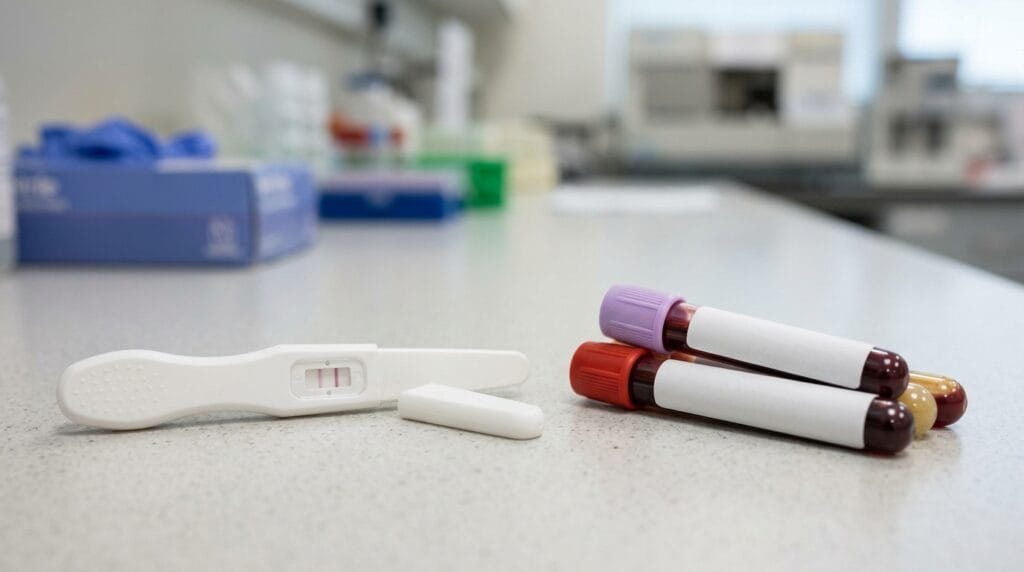

The timing matters. A faint test line appearing within the manufacturer’s specified reading window may represent a positive result. A mark that develops after the permitted reading period may instead be an evaporation line or another misleading change.
However, color, thickness, and photographs alone cannot reliably confirm every unclear result. Pregnancy tests vary in design and sensitivity.
This guide explains how these tests work, why faint lines happen, and when repeating a test or seeking medical advice makes sense.
Faint Positive Pregnancy Test: What Does a Light Line Mean?
Most home pregnancy tests detect human chorionic gonadotropin, or hCG, in urine. This hormone begins increasing after pregnancy develops.
Different tests use different indicators, including colored lines or digital displays. Therefore, the instructions supplied with the specific test are essential.
Why Early Pregnancy Tests Sometimes Show Faint Lines
A faint positive pregnancy test may happen when the amount of hCG in urine is relatively low.
This is particularly possible when testing very early, before or shortly after the expected period.
Low hCG and the Timing of Implantation
Pregnancy hormone levels do not begin increasing on the same calendar day for everyone.
Ovulation timing can vary. The timing of implantation can also differ between pregnancies.
As a result, two people testing on what they believe is the same cycle day may receive different results.
Even for the same person, one cycle may involve later ovulation than expected.
According to the U.S. Food and Drug Administration, testing too early is a major reason for false-negative home pregnancy tests.
The agency notes that some pregnant people will not receive a detectable positive result on the first day of a missed period.
For a more reliable result, waiting a few days can make a difference.
However, the shade of a line cannot be used to calculate the exact number of weeks of pregnancy.
Nor can it reliably determine whether a pregnancy is progressing normally.
Only appropriate medical evaluation can answer questions about pregnancy development when concerns arise.
Why First-Morning Urine May Be More Useful
Urine concentration can affect the amount of hCG present in the sample.
When a person drinks substantial amounts of fluid, urine may become diluted.
This can make very early pregnancy harder to detect.
The FDA recommends first-morning urine when trying to improve the chance of detecting low hCG levels.
However, pregnancy tests can also work at other times of day, particularly after hormone levels have increased.
Use the sample collection method specified by your test manufacturer.
Some products require holding the absorbent tip in a urine stream. Others allow dipping into a collected sample.
Using an incorrect amount of urine or leaving the strip immersed too long may produce an invalid result.
Check the expiration date before starting.
Then place the test on a suitable surface and read it at the instructed time.
Avoid repeatedly handling or moving the test while it develops.

Evaporation Line Versus a True Positive Result
One of the biggest sources of confusion is the evaporation line.
When urine dries on a test strip, a mark may become visible that was not present during the valid reading period.
Why Reading the Test Too Late Can Mislead You
According to Cleveland Clinic, an evaporation line may appear when a pregnancy test is checked after its designated reading period.
Many tests instruct users to read results within several minutes and disregard changes afterward.
However, the exact time window differs between products.
A line that develops after the deadline should not be interpreted using the same rules as a line that appeared during the valid window.
It is tempting to inspect a test repeatedly, especially when the first result was unclear.
Nevertheless, leaving the test on the counter for an hour and then discovering a second mark does not establish pregnancy.
The appropriate response is usually to repeat testing with a fresh, unexpired product.
Some online discussions claim that a particular color always identifies an evaporation line.
However, photographs, lighting, and test construction make those rules unreliable.
Timing and manufacturer instructions provide a better basis for interpretation.
Indent Lines, Test Sensitivity, and Digital Results
Some line-based pregnancy tests have visible indentations where their test indicator is designed to develop.
Under certain lighting, these may look like faint marks even without a clearly positive result.
Different products also have different hCG detection thresholds.
A person might receive a visible result on one brand while another remains negative because the tests have different sensitivities.
However, comparing lines between brands is not a reliable method for measuring hormone levels.
Digital tests may remove some ambiguity about reading colored lines.
Nevertheless, they still depend on the underlying hormone level and correct testing procedures.
A digital negative result obtained too early can also be misleading.
If uncertainty continues, healthcare professionals can explain whether clinical testing is appropriate.
What to Do After an Unclear Pregnancy Test Result
One ambiguous home test does not require endless guessing. A clear follow-up plan can provide more useful information.
Retesting, Blood Tests, and When to Seek Medical Care
Start by identifying whether the result appeared within the valid reading period and whether the control indicator worked correctly.
Retest after several days.
If the test is unclear, repeat it after a few days using a new test.
The FDA explains that hCG generally increases rapidly during early pregnancy, so a later test may be easier to interpret.
Use first-morning urine when possible and follow the instructions carefully.
However, do not treat progressively darker home-test lines as a reliable substitute for medical assessment.
Urine concentration and test differences can affect line intensity.
Make sure the control indicator appears.
Many line tests include a control line showing that the test functioned according to its design.
If the required control indicator does not appear, the result is invalid.
Follow the manufacturer’s instructions and use a fresh test.
An invalid test cannot establish whether pregnancy is present.
Consider a blood pregnancy test.
Healthcare professionals may use blood testing to detect or measure hCG when the situation requires further evaluation.
A qualitative blood test indicates whether hCG is detected.
A quantitative blood test measures its concentration.
However, a single hCG result may not provide all the information needed to assess early pregnancy.
Depending on the circumstances, clinicians may recommend follow-up testing or ultrasound.
Read our negative pregnancy test guide if you continue experiencing symptoms despite negative results.

What if the second test is still unclear?
If repeated tests remain ambiguous, speak with a healthcare professional rather than relying on increasingly detailed photographs.
A clinician can review cycle timing, symptoms, medicines, and test results.
They may also consider other explanations for a missed period.
For example, irregular ovulation, illness, stress, and certain medications can affect menstrual timing.
However, symptoms alone cannot establish which explanation is correct.
Know the warning signs that require immediate attention.
Severe one-sided abdominal pain, shoulder-tip pain, fainting, significant dizziness, or heavy bleeding may signal an urgent medical problem, including ectopic pregnancy.
Seek emergency medical care when these symptoms occur.
Do not wait for a home test to become clearly positive before seeking help for severe symptoms.
The NHS ectopic pregnancy guidance explains these warning signs.
What if you were hoping for a positive result?
A faint or uncertain result can be emotionally intense when you are trying to conceive.
However, one ambiguous test cannot reliably predict what will happen next.
Following the recommended testing interval may provide more useful information than testing repeatedly within the same day.
If your cycle is irregular, ask a healthcare professional about when further evaluation makes sense.
What if pregnancy is unexpected?
You do not need to decide everything based on an unclear line.
Start by obtaining a reliable result and identifying whether urgent medical symptoms are present.
Once pregnancy is confirmed, you can discuss your health and options with a qualified professional.
Our pregnancy options counseling article explains how to seek nonjudgmental support.
Frequently asked questions
Can a very faint second line mean pregnancy?
Yes, when it appears within the product’s valid reading period and meets the manufacturer’s criteria.
Is a line that appears an hour later positive?
Do not interpret a line appearing after the reading deadline as a valid positive result.
Should I test again tomorrow?
Waiting several days may produce a clearer result, particularly when the first test was taken very early.
Can a blood test help?
Yes. A clinician may recommend blood hCG testing when home results are unclear or medical assessment is needed.
Final thoughts
A faint positive pregnancy test should be interpreted according to the test’s instructions, especially its reading window.
Retesting after several days or seeking clinical confirmation is more reliable than analyzing a dried strip.
When serious symptoms occur, prioritize medical assessment rather than additional home testing.
Medical note: This article is educational and cannot diagnose pregnancy or complications.