
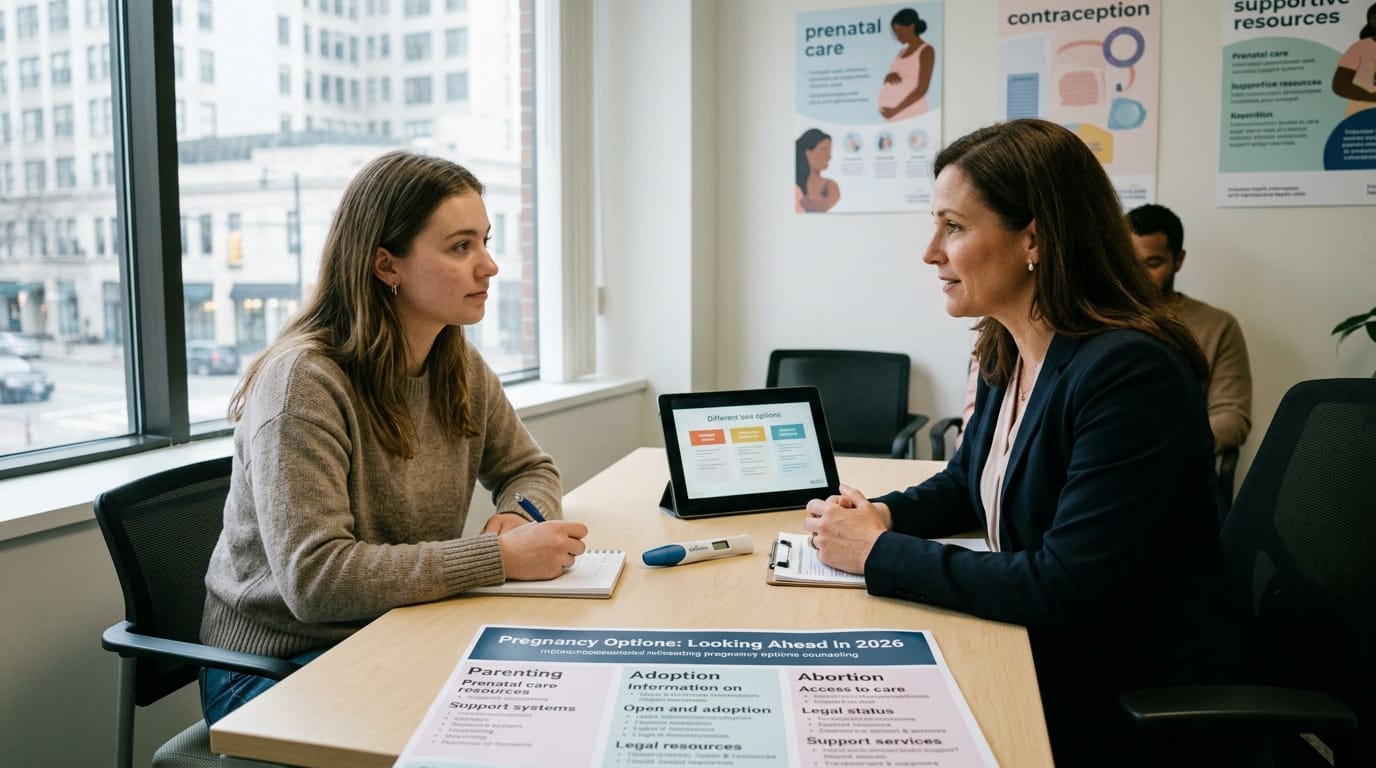
A positive pregnancy test does not always bring one clear emotion. You may feel excited, scared, calm, shocked, confused, relieved, worried, or several of those feelings at the same time.
You may also have no idea what you want to do next.
In 2026, the American College of Obstetricians and Gynecologists, or ACOG, released new guidance on person-centered pregnancy options counseling. The guidance focuses on giving people clear information without assuming how they feel about a pregnancy or what decision they should make.
That matters because uncertainty after a positive pregnancy test is normal. You do not need to have every answer within the first hour or even the first day.
Pregnancy options counseling is meant to help you understand your situation, ask questions, discuss your values and concerns, and learn what care may be available to you.
It is not supposed to pressure you toward one outcome.
If you are still confirming whether you may be pregnant, start with our step-by-step guide on what to do if you think you might be pregnant.
What Pregnancy Options Counseling Means in 2026
ACOG describes pregnancy options counseling as a person-centered process. In simple terms, the conversation should focus on you rather than on assumptions about what someone in your situation is expected to choose.
A healthcare professional may ask how you feel about the pregnancy, what concerns you have, what support is available, and what information you need before making a decision.
The discussion can include continuing the pregnancy and receiving prenatal care. It may also include abortion care and continuing a pregnancy without planning to parent, such as through adoption. Actual services and legal access can vary by location.
The important part is that counseling should provide accurate information while allowing you to think about your own goals and circumstances.
You Are Allowed to Feel Unsure After a Positive Test
Some people know immediately that they want to continue a pregnancy. Others know quickly that they do not. Many people fall somewhere between those two points.
You might need time because the pregnancy was unexpected. You may have financial concerns, relationship questions, health issues, work responsibilities, school plans, or existing children to consider.
Even a planned pregnancy can create unexpected uncertainty once the test actually turns positive.
ACOG’s 2026 guidance specifically recognizes that a person may feel ambivalent or may choose to delay a decision while gathering information.
That does not mean you should ignore medical care. It means emotional certainty and medical next steps do not always happen at the same speed.
A Good Counseling Conversation Should Not Assume Your Decision
A healthcare professional should not decide how you feel based on your age, relationship status, income, religion, health history, or whether the pregnancy was planned.
Instead, the conversation should include open questions.
You might hear questions such as:
- How are you feeling about the pregnancy?
- What concerns are most important to you right now?
- What information would help you make a decision?
- Who, if anyone, would you like involved in the conversation?
- Are there medical, financial, family, or safety issues affecting your choices?
You can also tell the clinician that you are unsure.
Do not have to pretend to be excited if you are worried. Also do not need to act upset if the pregnancy is something you hoped for.
Good counseling should make room for your real reaction.
Shared Decision-Making Means Information Plus Your Values
Shared decision-making does not mean that the doctor makes the decision for you. It also does not mean that you are expected to figure everything out without professional guidance.
The idea is to combine reliable medical information with what matters to you.
For example, a clinician may explain how far along the pregnancy may be, whether certain medications require attention, and whether you need testing or an ultrasound. You then have space to explain your priorities and concerns.
Some decisions are also affected by time. Available care may depend on gestational age, medical needs, local laws, insurance, travel distance, or appointment availability.
This is why getting accurate information early can be helpful even if you have not made a final decision.
ACOG’s 2026 guidance on person-centered pregnancy options counseling explains the professional recommendations in more detail.
What to Do Before You Have the Counseling Conversation
You do not need to prepare a perfect list of questions. Still, a few basic details can make the conversation more useful.
Start with the date of your last period if you know it. Write down when you took the pregnancy test and whether you took more than one.
Make a list of prescription medicines, over-the-counter drugs, vitamins, supplements, and recreational substances you currently use. Do not stop an important prescription on your own unless a healthcare professional tells you to do so.
Also think about what you actually want from the appointment.
You may want confirmation that you are pregnant. You may want help estimating how far along you are. Want information about prenatal care. May want to discuss all available pregnancy options. Or you may simply need someone to explain what happens next.
If you are unsure whether the home test itself is reliable, read our guide on pregnancy-test timing and accuracy.
Write Down the Questions You Are Afraid You Will Forget
A positive test can make it hard to remember everything once you are sitting in an appointment.
Writing down questions can help.
You might ask:
- How far along might I be?
- Do I need another pregnancy test or blood test?
- When would an ultrasound be useful?
- Are my current medications safe if I continue the pregnancy?
- What options are available where I live?
- How much time do I have to make decisions?
- What symptoms would require urgent medical care?
- What resources are available if cost or transportation is a problem?
You can also ask to speak privately.
If a partner, family member, or friend comes with you, you may still want part of the appointment alone with the healthcare professional. That can make it easier to ask personal questions or discuss concerns without pressure from someone else.
How to Protect Your Health While You Are Still Deciding
Being uncertain about the future of the pregnancy does not mean you should ignore your health in the meantime.
If there is a chance you may continue the pregnancy, ask a clinician about prenatal vitamins and folic acid. Avoid alcohol and smoking while you are waiting for medical guidance. Ask before starting or stopping medications.
If you have a medical condition such as diabetes, epilepsy, high blood pressure, or another condition that requires regular treatment, contact the clinician who manages it. Medication changes should be handled carefully.
Emotional health matters too. You may want support from someone you trust, but you are not required to tell everyone immediately.
Privacy can be especially important if you use apps or websites while figuring out your next steps. Our pregnancy app privacy guide for 2026 explains what to consider before storing sensitive cycle, symptom, or pregnancy information online.
Know Which Symptoms Should Not Wait for a Counseling Appointment
Most people with a new positive pregnancy test do not need emergency care simply because the test is positive.
Some symptoms are different.
Seek urgent medical attention for severe or worsening abdominal or pelvic pain, especially if it is mainly on one side. Heavy bleeding, fainting, severe dizziness, or shoulder pain also deserve prompt medical evaluation.
These symptoms can have several causes. One concern in early pregnancy is ectopic pregnancy, which happens when a pregnancy develops outside the uterus and can become dangerous if it ruptures.
Do not wait for a routine prenatal or counseling appointment if you feel seriously unwell.
You Can Take the Next Step Without Having the Whole Future Planned
After a positive pregnancy test, it can feel as if you are supposed to decide everything at once.
You are not.
The first step might simply be confirming the pregnancy. The next may be talking with a healthcare professional. After that, you may need more information about your health, your pregnancy, available care, finances, or support.
If your first clinician makes assumptions about what you want or refuses to answer reasonable questions, you can ask for clarification or seek another qualified provider when that option is available.
Person-centered counseling should help you understand your choices rather than make you feel judged for needing time.
That idea is at the center of ACOG’s 2026 guidance.
A positive pregnancy test can be life-changing, but you do not need to perform the “correct” emotion. Be happy and scared. You can feel uncertain. know exactly what you want. You can also need more information before deciding anything.
Start with facts instead of pressure. Confirm the pregnancy when needed. Review your medications and health needs. Write down your questions. Speak with a qualified healthcare professional who can explain your options and respect your values.
Your next step does not have to answer every question about the months ahead. It only needs to help you move from uncertainty toward clearer, safer information.
Medical disclaimer: This article is for general educational purposes only and is not a substitute for medical advice, diagnosis, or treatment. Pregnancy care and available options vary based on medical circumstances and location. Seek urgent medical care for severe pain, heavy bleeding, fainting, severe dizziness, or other concerning symptoms.