

A cryptic pregnancy negative pregnancy test sounds almost impossible. You may have seen stories online about someone who continued having bleeding, had few obvious symptoms, kept getting negative home tests, and then discovered months later that they were pregnant.
Cryptic pregnancy is real, but it is uncommon. It means a pregnancy goes unrecognized for much longer than usual. Sometimes a person does not realize they are pregnant until the second trimester. In much rarer situations, pregnancy may not be recognized until very late.
However, cryptic pregnancy does not usually mean that pregnancy somehow produces no pregnancy hormone or that every medical test stays negative for nine months. Home tests can be falsely negative, especially when taken too early or used incorrectly. Once a pregnancy is established, healthcare professionals can usually confirm it through urine testing, blood testing, ultrasound, or a combination of these methods.
If you have pregnancy symptoms but continue seeing negative results, the goal should not be to diagnose yourself with a cryptic pregnancy. Instead, look carefully at when you tested, how you tested, your menstrual history, and whether it is time to speak with a healthcare professional.
What a Cryptic Pregnancy Really Means
A cryptic pregnancy, sometimes called a stealth pregnancy, is a pregnancy that goes unnoticed for an unusually long time. The pregnancy itself develops biologically like another pregnancy. What is different is that the person does not recognize that pregnancy is causing the changes happening in their body.
This may happen because symptoms are mild, cycles were already irregular, bleeding is mistaken for a period, pregnancy was considered unlikely, or early pregnancy tests produced misleading results.
Pregnancy symptoms also vary widely. One person may experience strong nausea, breast tenderness, exhaustion, and obvious menstrual changes. Another may have very few noticeable symptoms. Even different pregnancies in the same person can feel different.
If you are currently comparing symptoms, our guide to early signs of pregnancy before a missed period explains which changes commonly appear early and why symptoms alone cannot confirm pregnancy.
Why a pregnancy can sometimes go unnoticed
There is rarely one single explanation. Instead, several circumstances can make pregnancy harder to recognize.
Someone who normally has unpredictable cycles may not consider a missed period unusual. A person who recently gave birth may be waiting for regular menstrual cycles to return. Someone using birth control may assume pregnancy is impossible. People approaching menopause may interpret missed periods or body changes as perimenopause rather than pregnancy.
In addition, symptoms such as fatigue, bloating, nausea, breast tenderness, appetite changes, mood changes, and mild cramping have many possible causes. They can easily be attributed to stress, illness, PMS, digestive problems, medication, or everyday hormonal changes.
Irregular periods and light bleeding can hide an important clue
A true menstrual period does not continue normally during pregnancy. However, bleeding or spotting can occur during pregnancy, and some people may mistake that bleeding for a light or unusual period.
This distinction matters because seeing blood does not automatically rule pregnancy out. At the same time, spotting does not automatically mean pregnancy either.
If your periods have always been irregular, tracking whether you have actually “missed” one becomes difficult. Conditions that affect ovulation, changes in weight, stress, breastfeeding, perimenopause, and several health conditions can all affect menstrual timing.
That is one reason pregnancy testing should be based not only on your expected period date but also on when pregnancy could realistically have occurred.
Home pregnancy tests can be negative for ordinary reasons
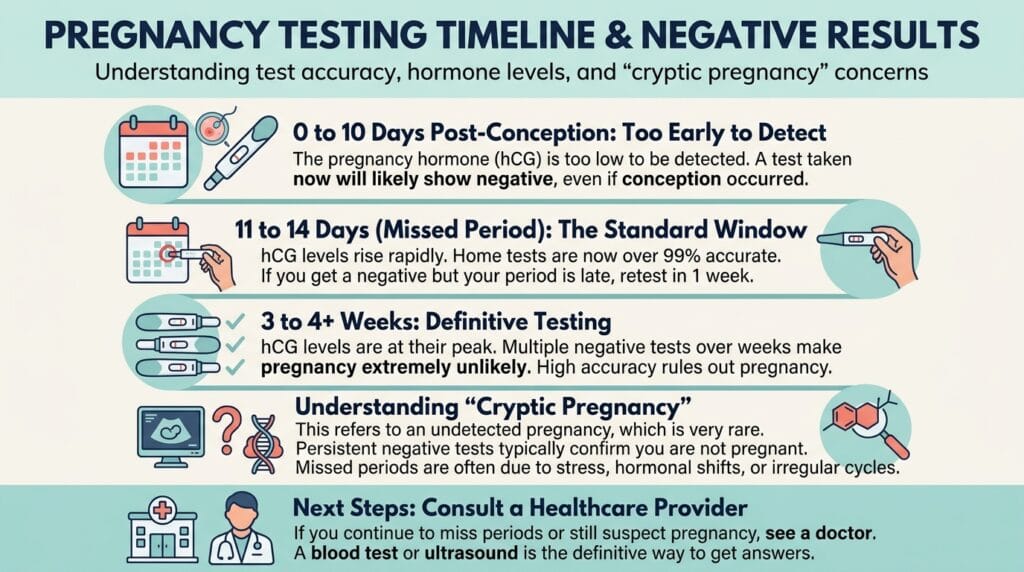
Home pregnancy tests detect human chorionic gonadotropin, commonly called hCG. Your body begins producing hCG after a fertilized egg implants and the placenta begins developing.
The most common explanation for a false-negative pregnancy test is simple: testing too early.
If ovulation happened later than expected, conception and implantation also happen later. A person may believe they are a week late based on an app while biologically being much earlier in the pregnancy than expected.
Other causes of false-negative results include diluted urine, checking the result at the wrong time, using an expired test, or not following the manufacturer’s instructions exactly.
Mayo Clinic’s updated 2026 pregnancy-testing guidance explains that home tests are generally more reliable after the first day of a missed period and recommends repeating a test or contacting a healthcare professional when a negative result does not match what is happening with your cycle.
For more details, read our guide on when to take a pregnancy test for the most accurate result.
Can a cryptic pregnancy really stay negative on home tests for months?
This is where online discussions about cryptic pregnancy often become misleading.
A person can be pregnant and receive a false-negative home test. That is well established. However, repeated negative tests over a long period should not automatically be interpreted as proof of a hidden pregnancy.
Cleveland Clinic explains that a cryptic pregnancy should still generally produce a positive pregnancy test. Incorrect testing or testing at the wrong time can cause a false negative, but pregnancy can also be evaluated using professional urine testing, blood testing, and ultrasound.
If you have taken only one test very early, repeating it later makes sense. If you have repeatedly tested negative after enough time has passed, continuing to buy home tests may provide less useful information than speaking with a healthcare professional.
Most established pregnancies produce detectable hCG
Once pregnancy develops, the placenta produces hCG. During early pregnancy, hCG typically rises quickly. This is what urine and blood pregnancy tests are designed to detect.
That does not mean every person’s hormone level follows exactly the same pattern. Nor does it mean every home test has identical sensitivity. But claims that a normal ongoing pregnancy routinely produces no detectable hCG for many months should be treated carefully.
If your home tests remain negative while your period stays absent or physical changes continue, a clinician can decide whether a blood pregnancy test, pelvic examination, ultrasound, or testing for another condition is appropriate.
This is especially important because pregnancy is not the only explanation for symptoms such as missed periods, abdominal bloating, breast changes, nausea, weight changes, or fatigue.
You may also find our article negative pregnancy test but still feel pregnant helpful. It explains other common reasons symptoms and home-test results may not seem to match.
What to Do If You Think You Are Pregnant but Tests Stay Negative

If pregnancy is possible and your first result is negative, start by checking the timing rather than assuming something unusual is happening.
If you tested before your expected period, wait and test again after your period is due. Your cycles are irregular, think about when you last had sex that could have resulted in pregnancy rather than relying only on a predicted period date.
Use an unexpired pregnancy test and follow every instruction. If you are testing early, first-morning urine is often useful because it is typically more concentrated. Avoid drinking a large amount of fluid immediately before testing.
You can review current medical guidance from the Mayo Clinic on home pregnancy test timing and false-negative results.
A practical testing and medical follow-up plan
If you are unsure what to do next, keep the process simple.
- Write down the date of the sexual encounter that could have caused pregnancy.
- Record the first day of your last clearly normal menstrual period.
- Note when you took each pregnancy test and the result.
- Repeat an early negative test after several days if your period has not started.
- Follow test instructions exactly and check the expiration date.
- Contact a healthcare professional if repeated tests remain negative but your period does not return or symptoms continue.
A clinician may order a blood test, which measures hCG differently from a home urine test. Depending on your symptoms and timing, an ultrasound may also help determine whether pregnancy is present and, if so, where it is located.
Do not assume that every unexplained abdominal sensation is fetal movement. Gas, intestinal movement, muscle contractions, bloating, and other normal body sensations can sometimes feel surprisingly similar. Likewise, changes in abdominal size can have many causes.
If pregnancy is confirmed later than expected, contact a pregnancy care provider so appropriate prenatal evaluation can begin. Your provider may review medications, supplements, health conditions, prenatal screening, nutrition, and other aspects of care based on how far along the pregnancy is estimated to be.
Know which symptoms should not wait for another home test
Some symptoms deserve medical attention regardless of whether a home pregnancy test is positive or negative.
Seek prompt medical care for severe or increasing pelvic or abdominal pain, especially pain concentrated on one side. Urgent evaluation is also appropriate for fainting, significant dizziness, shoulder pain, heavy bleeding, severe weakness, or symptoms that feel sudden or dangerous.
These symptoms do not prove that you have a cryptic pregnancy. They can have several causes. However, pregnancy complications such as ectopic pregnancy are among the conditions healthcare professionals may need to consider when pregnancy is possible and significant pain or bleeding is present.
If all pregnancy testing is negative, your healthcare professional can also investigate other reasons for a missed period or pregnancy-like symptoms. These may include hormonal changes, thyroid problems, PCOS, stress, major changes in weight or exercise, medications, perimenopause, or other medical conditions.
If you eventually receive a positive result, our step-by-step guide for what to do when you think you are pregnant can help you organize your next steps.
Bottom line: A cryptic pregnancy is possible, but it is uncommon. A person may miss the signs of pregnancy because of irregular cycles, subtle symptoms, unexpected bleeding, contraceptive use, or an early false-negative test. However, repeated negative home tests for months should not automatically be assumed to mean that pregnancy is hiding from every test. If pregnancy is still a concern after appropriate repeat testing, medical evaluation is the clearest way to find out what is happening.
This article is for general educational purposes only and is not a substitute for diagnosis, pregnancy testing, or personalized medical care from a qualified healthcare professional.