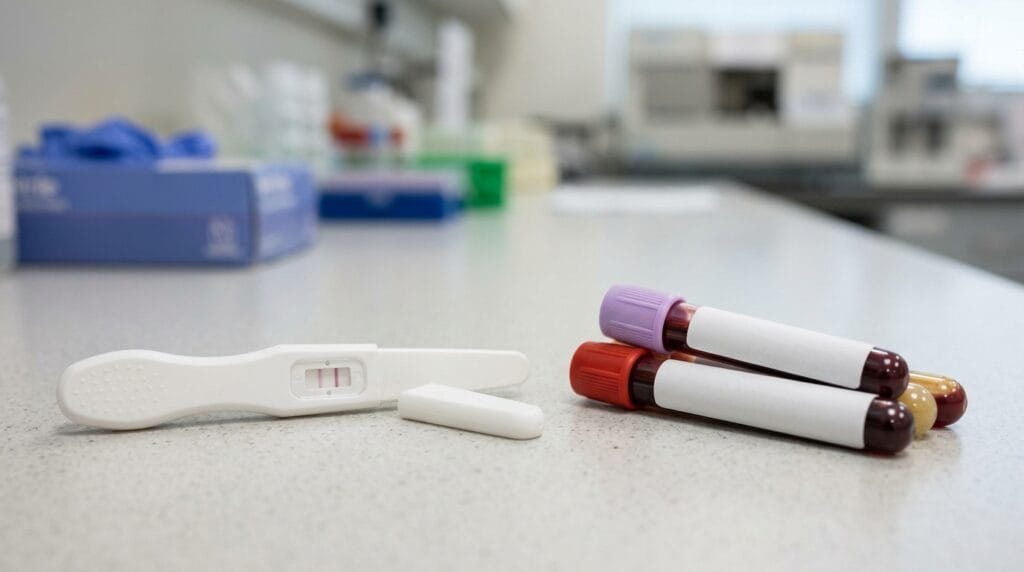

Pregnancy tests detect human chorionic gonadotropin, commonly called hCG. This hormone does not disappear immediately when a pregnancy ends. Consequently, a test can remain positive while hormone levels gradually decline.
However, a persistent positive result should not always be attributed to normal hormonal changes. Depending on the circumstances, it may require evaluation for remaining pregnancy tissue, a new pregnancy, or another medical condition.
This guide explains how hCG changes following pregnancy loss, when follow-up testing may be recommended, and which symptoms require medical attention.
Positive Pregnancy Test After Miscarriage: Why It Happens
After a miscarriage, the body needs time to adjust to changing pregnancy hormone levels.
The rate of decline depends on several factors, including the hormone level before the loss, how far the pregnancy had developed, and whether the miscarriage has fully resolved.
Understanding hCG Levels After Pregnancy Loss
Home pregnancy tests identify hCG in urine. They cannot determine whether the hormone comes from an ongoing pregnancy, a recent pregnancy loss, or another source.
Therefore, a positive result alone does not explain what is happening.
Why hCG Can Remain Detectable for Several Weeks
During pregnancy, hCG levels generally increase as pregnancy develops. After a miscarriage, those levels begin to fall.
However, the hormone can remain detectable for days or weeks.
The Royal College of Obstetricians and Gynaecologists explains that urine pregnancy tests may remain positive after pregnancy loss. It commonly recommends a follow-up home pregnancy test approximately three weeks after a confirmed miscarriage.
That does not mean everyone will receive a negative test on exactly the same day.
The time required for hCG to decline varies from person to person.
For example, someone experiencing a very early pregnancy loss may have a different pattern of hormone decline from someone whose pregnancy ended later in the first trimester.
The way the miscarriage was managed can also influence the follow-up plan.
Some people experience a complete miscarriage without medication or surgery. Others need medical or surgical management.
Because of those differences, individualized follow-up instructions are important.
Why Different Pregnancy Tests May Show Different Results
Home pregnancy tests do not all detect identical concentrations of hCG.
Some products are designed to detect lower hormone levels than others.
As hCG decreases, a sensitive test may still show a positive result while another test appears negative.
Urine concentration may also influence the result.
For instance, a concentrated morning sample can contain a different detectable hormone concentration than a heavily diluted sample.
However, the darkness of a pregnancy test line cannot reliably determine the exact hCG level.
Comparing photographs of test strips over several days is not a substitute for clinical evaluation.
Likewise, a fading line does not by itself confirm that a miscarriage has completely resolved.
Follow your clinician’s recommended testing schedule rather than repeatedly testing without a clear plan.

When a Positive Test May Require Further Investigation
Although residual hCG is a common explanation, other possibilities require consideration.
A healthcare professional can assess these possibilities using your medical history, symptoms, blood tests, and ultrasound when appropriate.
Retained Pregnancy Tissue and Other Medical Concerns
Sometimes pregnancy tissue remains in the uterus after a miscarriage.
This may be described as retained products of conception.
Depending on the circumstances, retained tissue can contribute to prolonged bleeding, infection, or persistent hCG production.
However, a positive home test does not prove retained tissue is present.
Similarly, a negative pregnancy test does not explain every symptom that may occur after pregnancy loss.
Other conditions may need investigation, including ectopic pregnancy or, more rarely, molar pregnancy.
The National Institute for Health and Care Excellence recommends clinical review when a home pregnancy test remains positive three weeks after medical management of miscarriage.
The same guidance includes follow-up testing after expectant management when symptoms indicate the miscarriage has completed.
Contact your healthcare professional earlier if bleeding or pain persists, worsens, or causes concern.
Do not wait for the three-week test if you develop urgent symptoms.
Can a New Pregnancy Cause Another Positive Test?
Yes. Ovulation may return before the first menstrual period after miscarriage.
Therefore, a new pregnancy is possible even if menstruation has not resumed.
ACOG explains that pregnancy may occur as soon as approximately two weeks after an early miscarriage.
However, a positive test soon after pregnancy loss cannot independently distinguish a new pregnancy from declining hCG related to the earlier one.
Healthcare professionals may consider the timing of intercourse, previous hormone measurements, and additional testing.
When needed, quantitative blood hCG measurements can help clinicians assess the pattern over time.
Ultrasound may also be appropriate depending on the situation.
If you do not want to become pregnant again immediately, discuss suitable contraception with your healthcare professional.
If you would like to try again, ask about your medical recovery and any individualized recommendations.
What to Do if Your Pregnancy Test Stays Positive
Persistent positive results deserve an organized approach rather than assumptions about what the test means.
Follow the instructions supplied by your healthcare team, particularly if you received medication or underwent a procedure for pregnancy loss.
Follow-Up Testing, Warning Signs, and Recovery
A clinician may recommend a combination of symptom review, urine testing, blood tests, and ultrasound.
The appropriate plan depends on how the pregnancy loss was diagnosed and managed.
Follow the recommended pregnancy test schedule.
RCOG guidance commonly recommends a home pregnancy test three weeks after miscarriage.
If the result remains positive at that time, contact the healthcare team responsible for your care.
They may recommend further evaluation rather than simply asking you to wait indefinitely.
However, if your clinician provided a different individualized schedule, follow that plan.
Pregnancy loss care varies, and your medical circumstances may require earlier assessment.
Understand why blood hCG tests may be ordered.
A quantitative blood test measures the concentration of hCG.
Clinicians sometimes repeat the measurement to assess how the level changes.
A decreasing level can provide useful information, but interpretation depends on the clinical context.
For example, an unusual pattern might prompt an ultrasound or additional testing.
However, a single blood measurement cannot reliably establish every aspect of pregnancy location or recovery.
Do not use online charts to diagnose a complication from one laboratory result.
Know the signs that need urgent medical care.
Seek emergency medical attention for severe abdominal or pelvic pain, fainting, significant dizziness, shoulder-tip pain, or heavy bleeding.
These symptoms can sometimes occur with serious complications, including ectopic pregnancy or substantial blood loss.
Fever, worsening pain, or foul-smelling vaginal discharge may also indicate a complication requiring prompt medical evaluation.
Do not delay medical care while waiting for a pregnancy test to become negative.

What if you have no symptoms?
Even without pain or bleeding, a persistently positive pregnancy test may need medical review.
Some conditions do not produce obvious symptoms in their early stages.
If you have reached the recommended follow-up date and the test remains positive, contact your clinician.
Explain when the miscarriage occurred and whether you received medication or a procedure.
This information helps the healthcare team determine appropriate next steps.
What if the test becomes negative?
A negative result may be reassuring when it occurs as expected within the recommended follow-up plan.
However, any continuing pain, fever, unusual discharge, or heavy bleeding should still be assessed.
Do not assume that a negative urine test excludes every possible post-miscarriage complication.
Continue following medical instructions about appointments, medications, and recovery.
When will your period return?
Menstrual cycles may take several weeks to resume after miscarriage.
The timing varies according to hormonal changes and individual circumstances.
Because ovulation can occur before menstruation, the first period is not a reliable indicator of when fertility returns.
If your cycle does not return as expected or you experience new symptoms, discuss those changes with a healthcare professional.
They can decide whether further assessment is appropriate.
How to handle uncertainty during recovery.
Pregnancy loss can involve emotional as well as physical changes.
A continued positive result may be particularly difficult because it can prolong uncertainty.
However, the presence of hCG does not determine how someone should feel about their experience.
Some people want detailed medical explanations, while others prefer to focus on immediate recovery.
Both approaches can be discussed with a healthcare professional.
Support may include counseling, trusted family members, friends, or pregnancy-loss support groups.
There is no fixed emotional recovery schedule.
Useful questions for your healthcare appointment.
Ask whether your miscarriage has been confirmed as complete and whether additional testing is necessary.
You can also ask when to repeat a pregnancy test, which symptoms should prompt earlier contact, and when you might expect your menstrual cycle to return.
If the test remains positive, ask whether blood hCG measurements or ultrasound would help explain the result.
Keep copies of important results and appointment instructions.
These records may be useful if another healthcare professional becomes involved in your care.
Frequently asked questions
Can a pregnancy test stay positive two weeks after miscarriage?
Yes. hCG may remain detectable for days or weeks after pregnancy loss.
What if my test is positive after three weeks?
Contact your healthcare professional for review, as recommended in RCOG and NICE guidance.
Does a faint line mean the miscarriage is complete?
No. Line intensity cannot confirm that all pregnancy tissue has passed or that recovery is complete.
Can I become pregnant before my next period?
Yes. Ovulation can occur before menstruation resumes.
Do I need emergency care for a positive test alone?
A positive result alone is not necessarily an emergency. However, severe pain, fainting, shoulder-tip pain, or heavy bleeding require emergency evaluation.
Final thoughts
A positive pregnancy test after miscarriage often reflects hCG that has not yet returned to an undetectable level.
However, ongoing positive results may also indicate a condition requiring medical follow-up.
Follow the testing schedule recommended by your healthcare professional, contact them when results remain positive, and seek urgent care if concerning symptoms develop.
For more information about interpreting pregnancy tests, visit Could Be Pregnant.
Medical disclaimer: This article is for educational purposes only. It cannot determine whether a miscarriage is complete or diagnose complications.