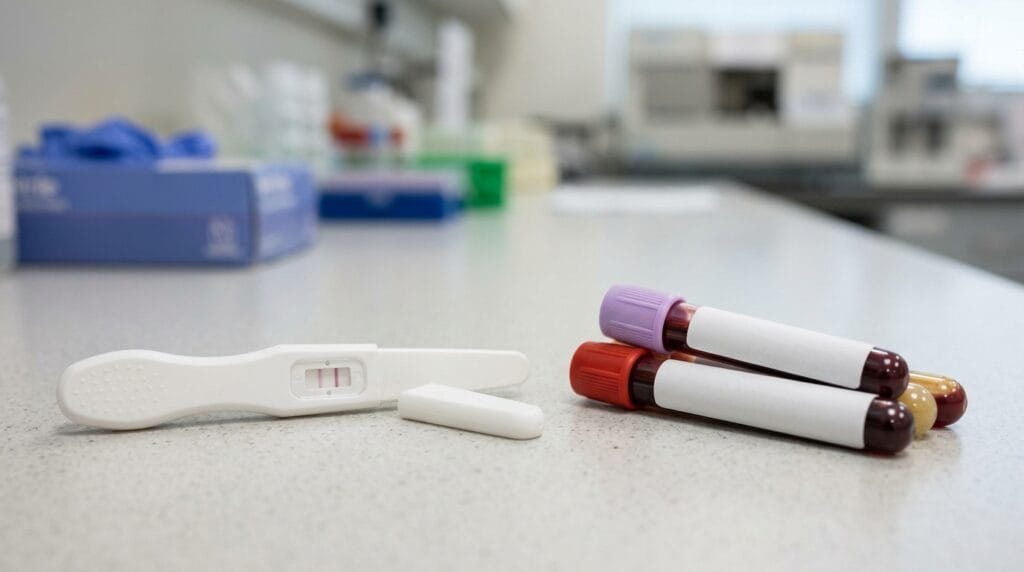

An IUD is one of the most effective reversible forms of contraception. Nevertheless, no contraceptive method prevents every pregnancy.
If you have a positive pregnancy test while an IUD may still be in place, contact a healthcare professional promptly. The pregnancy’s location needs to be assessed because ectopic pregnancy is a particular concern when pregnancy occurs with an IUD.
Do not attempt to remove the device yourself. A clinician should determine whether and how it can be removed safely.
This guide explains possible symptoms, why pregnancy location matters, and what happens during medical evaluation.
Pregnant With an IUD: How Can Pregnancy Happen?
Intrauterine devices are small contraceptive devices placed inside the uterus by trained healthcare professionals.
There are hormonal and copper IUDs, and both provide highly effective pregnancy prevention.
However, effectiveness does not mean the possibility of pregnancy is zero.
Understanding IUD Effectiveness and Pregnancy Symptoms
Pregnancy may occur despite an IUD being in place.
Another possible explanation is that the device has become displaced or expelled without the person realizing it.
Hormonal IUDs and Copper IUDs
Hormonal IUDs release a progestin that helps prevent pregnancy through several mechanisms.
Copper IUDs work without hormones and primarily affect sperm function and fertilization.
Both types are highly effective when appropriately used.
However, devices have different approved durations and manufacturer instructions.
For example, one hormonal IUD may be approved for a different length of use than another.
Do not assume every product lasts the same number of years.
A healthcare professional can review which device you have and when it was placed.
Pregnancy may occasionally occur even when the device is still within its approved duration.
Therefore, a positive test should not be dismissed simply because you believe the IUD is functioning normally.
Medical assessment is needed to clarify what has happened.
Missed Periods, Spotting, and Other Possible Signs
Pregnancy symptoms while using an IUD may resemble symptoms experienced without contraception.
Possible signs include nausea, breast tenderness, fatigue, and changes in bleeding.
However, hormonal IUDs can also cause lighter periods or no periods at all.
Consequently, missing a period may be less useful as a warning sign for some IUD users.
Spotting and irregular bleeding may also occur because of contraception-related changes.
However, bleeding cannot reliably distinguish a contraceptive effect from pregnancy or a medical complication.
If pregnancy is possible, use a home pregnancy test according to the manufacturer’s instructions.
Our negative pregnancy test guide explains why early testing may not detect every pregnancy.
If the test is positive while an IUD may be in place, arrange prompt clinical assessment even without obvious pain.

Why Ectopic Pregnancy Is an Important Concern
An ectopic pregnancy occurs when a pregnancy develops outside the uterus.
It most commonly develops in a fallopian tube and requires medical treatment.
Understanding Relative Risk and Emergency Symptoms
An important distinction is that IUDs reduce the overall likelihood of pregnancy, including ectopic pregnancy.
However, when pregnancy does happen with an IUD in place, a greater proportion of those pregnancies may be ectopic compared with pregnancies occurring without an IUD.
This is why clinicians need to identify where the pregnancy is located.
According to the CDC, evaluation for possible ectopic pregnancy is the first important step when an IUD user is found to be pregnant.
Potential symptoms include one-sided pelvic pain, vaginal bleeding, shoulder-tip pain, dizziness, or fainting.
However, an ectopic pregnancy may cause few symptoms at first.
Do not assume the pregnancy is in the uterus merely because you feel well.
If you develop severe abdominal pain, fainting, marked dizziness, or shoulder-tip pain, seek emergency medical attention immediately.
These symptoms may indicate dangerous internal bleeding.
The NHS ectopic pregnancy guide describes warning signs and emergency treatment.
Why You Should Not Remove an IUD Yourself
If a home test is positive, it may be tempting to pull on the IUD strings immediately.
Do not attempt to remove the device yourself.
Self-removal during a possible pregnancy can create avoidable risks, particularly when the device’s position is uncertain.
A healthcare professional should evaluate the pregnancy and determine the appropriate next step.
The CDC recommends removal when it can be performed safely, such as when the strings are visible or can be retrieved from the cervical canal.
However, an IUD that cannot be safely reached may require different management.
Ultrasound may help determine where the device is located.
There can be risks both from a retained IUD and from removal.
Those decisions belong in a clinical setting with individualized counseling.
What to Do After a Positive Pregnancy Test With an IUD
The most useful next step is prompt contact with a qualified healthcare professional who can evaluate early pregnancy.
Explain that you have an IUD and a positive pregnancy test.
Medical Evaluation, IUD Removal, and Follow-Up Care
Clinical care depends on pregnancy location, symptoms, IUD type, device position, and the person’s preferences.
Contact a healthcare professional promptly.
Do not wait for a routine annual visit.
Tell the clinic when the test became positive, whether you have pain or bleeding, and which IUD you use.
If you know the insertion date, include that information.
However, do not delay seeking help just because you cannot remember the device’s exact name.
The clinician can review your history and plan appropriate evaluation.
Expect testing to determine pregnancy location.
Depending on gestational timing and symptoms, the clinician may recommend blood hCG testing and ultrasound.
The purpose is to establish whether the pregnancy is located inside the uterus and assess possible complications.
However, a very early pregnancy may not yet be visible on ultrasound.
Additional testing or follow-up may then be needed.
A single blood result does not always establish the location of a pregnancy.
Follow the clinician’s instructions for return visits and urgent symptoms.

What happens if the pregnancy is inside the uterus?
If an intrauterine pregnancy is confirmed, the clinician will discuss the person’s preferences and the risks associated with the IUD.
The CDC explains that leaving an IUD in place increases the risk of miscarriage, infection, and preterm delivery.
Removing the device when it can be done safely reduces some of those risks.
However, removal does not eliminate all risks or guarantee a particular outcome.
The appropriate management depends on the individual circumstances.
What if the IUD strings are not visible?
Missing strings do not necessarily mean the device has disappeared.
Sometimes the strings have moved into the cervical canal or uterus.
The device may also be displaced or, less commonly, expelled.
A clinician can evaluate its location and determine whether removal is possible without an invasive procedure.
Do not use household objects or other tools to search for the strings.
Contact a healthcare professional instead.
Can someone continue the pregnancy?
Some intrauterine pregnancies that occur with an IUD can continue, but they require individualized counseling about risks.
When considering continued pregnancy, discuss device removal and the recommended monitoring plan.
Watch for pain, fever, heavy bleeding, or unusual discharge and seek prompt medical care if these develop.
However, an article cannot predict the outcome of an individual pregnancy.
Qualified medical assessment is necessary.
What if the pregnancy is unexpected?
Some people feel surprised or uncertain after receiving a positive test despite using effective contraception.
You can ask a healthcare professional to explain available options without pressure.
Urgent medical assessment for possible ectopic pregnancy should occur regardless of what you are considering afterward.
Our pregnancy options counseling guide discusses how to seek supportive care.
How should future contraception be discussed?
After the immediate medical situation has been addressed, a clinician can explain future contraceptive choices.
The appropriate option may depend on health history, pregnancy plans, and personal preferences.
A previous contraceptive failure does not mean every effective method will fail.
However, individual counseling can help identify any device-position concerns or other relevant factors.
Do not restart or change contraception without understanding the medical plan.
Frequently asked questions
Can an IUD cause a false-positive pregnancy test?
An IUD itself does not normally produce the hCG detected by pregnancy tests.
Is pregnancy with an IUD always ectopic?
No. However, ectopic pregnancy must be evaluated promptly.
Should I remove the IUD at home?
No. A healthcare professional should decide if and how removal can be performed safely.
Can an ultrasound help?
Yes. Ultrasound may help assess pregnancy location and the position of the IUD.
What symptoms require emergency care?
Severe abdominal pain, shoulder-tip pain, fainting, or significant dizziness require immediate medical assessment.
Final thoughts
Pregnancy with an IUD is uncommon, but a positive test requires prompt medical evaluation.
The immediate priority is confirming the pregnancy’s location and discussing how to manage the device safely.
Do not remove the IUD yourself, and seek emergency care for symptoms that could indicate internal bleeding.
Medical note: This article provides general educational information and does not replace medical examination or individualized counseling.