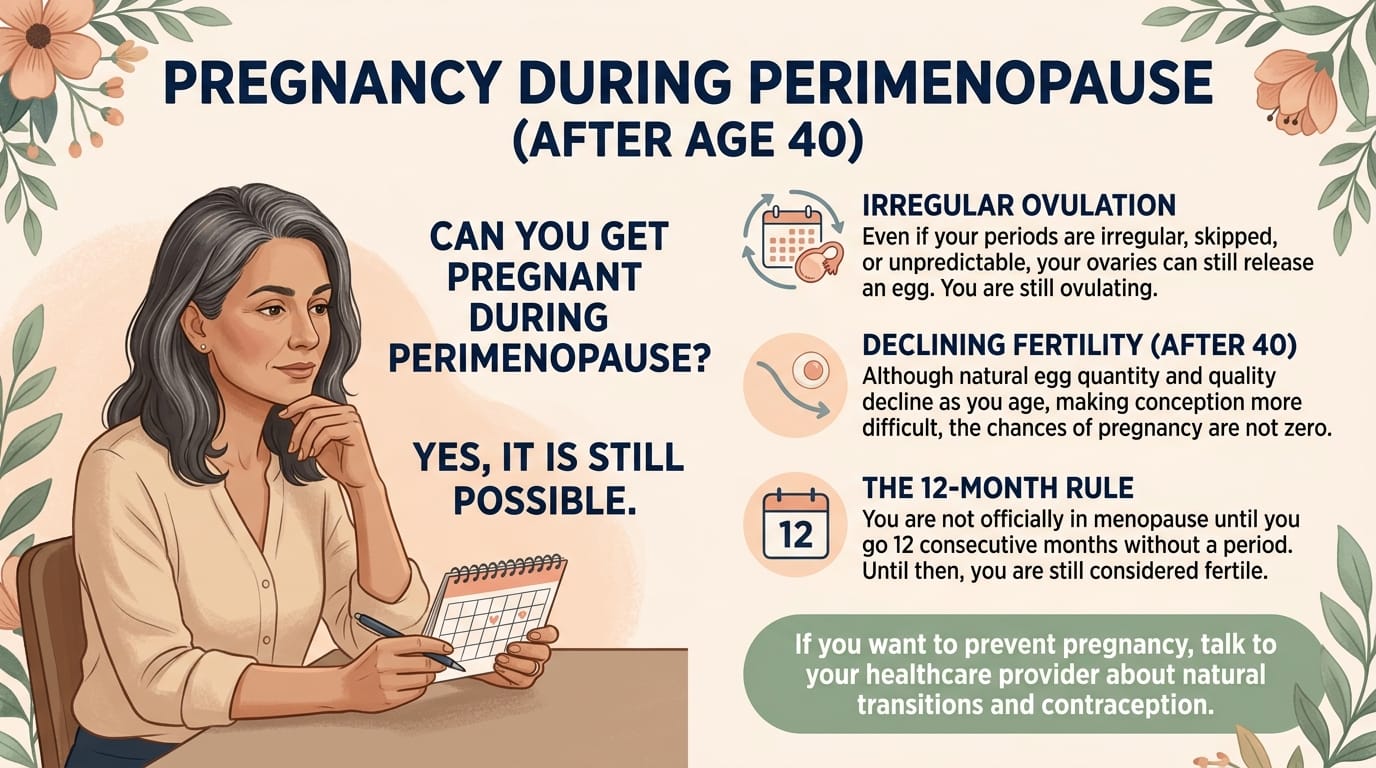
If you are in your 40s and your period suddenly does not arrive, you may wonder whether the cause is pregnancy or the beginning of perimenopause. The question can you get pregnant during perimenopause has a simple answer: yes. Fertility declines as you get older, but pregnancy can still happen as long as ovulation is still occurring.
That can make this stage of life confusing. Perimenopause can cause irregular cycles, skipped periods, breast tenderness, sleep changes, mood changes, and fatigue—symptoms that may overlap with early pregnancy. Instead of guessing from symptoms, consider whether pregnancy was possible and test at an appropriate time.
Can You Get Pregnant During Perimenopause?
Perimenopause is the transition leading up to menopause. During this time, estrogen and progesterone levels fluctuate, periods often become less predictable, and ovulation may not happen every month. However, less frequent ovulation is not the same as no ovulation.
Mayo Clinic explains that fertility decreases during perimenopause because ovulation becomes less regular. Still, if you are having periods, pregnancy remains possible. Menopause is generally reached after 12 consecutive months without a menstrual period, vaginal bleeding, or spotting that is not explained by another cause.
This means that a 40-, 43-, or 47-year-old who has irregular periods should not automatically assume that every missed cycle is menopause. If pregnancy is possible, a home pregnancy test can provide much more useful information than symptoms alone.
You can review current medical information in the Mayo Clinic guide to perimenopause.
Why pregnancy is still possible in your 40s

Pregnancy requires ovulation, fertilization, and implantation. During perimenopause, the ovaries may release eggs less consistently, but an occasional ovulation can still create a fertile window.
The challenge is that you may not know when that window occurs. During perimenopause, one cycle may be short, another long, and another may not include ovulation at all.
Age also affects the number and quality of remaining eggs. According to current guidance from the American College of Obstetricians and Gynecologists, fertility begins declining earlier in adulthood and falls more quickly in the mid-30s. By age 40, ACOG estimates that roughly 1 in 10 healthy women may become pregnant in a single menstrual cycle. That is lower than at younger ages, but it is clearly not zero.
Irregular ovulation makes timing harder to predict
One of the biggest mistakes is assuming that an irregular period means you are no longer ovulating. Ovulation can happen unexpectedly during perimenopause. Therefore, pregnancy can occur even after several unusual cycles.
This unpredictability also makes pregnancy-test timing harder. If you ovulated later than you thought, a test taken on the date your period was expected may actually be too early. The result could be negative simply because pregnancy hormone levels have not risen enough yet.
If you are unsure when to test, see our guide on when to take a pregnancy test and how timing affects accuracy.
A missed period can mean pregnancy or perimenopause
A missed period is one of the best-known early pregnancy signs, but it is also extremely common during perimenopause. Some people skip one month and then have another period. Others may go several months between cycles before bleeding returns.
Because of that overlap, the absence of a period cannot tell you which explanation is correct.
Think instead about pregnancy risk. If you have had vaginal sex since your last normal period, contraception failed, or birth control was missed, testing is reasonable even if you believe perimenopause has started.
Pregnancy symptoms vs. perimenopause symptoms
Early pregnancy and perimenopause can feel surprisingly similar because both involve major hormonal changes. Fatigue, mood changes, breast tenderness, headaches, sleep changes, bloating, and changes in menstrual bleeding may appear in either situation.
Pregnancy may also cause nausea, increased urination, food aversions, heightened sensitivity to smells, and persistent breast changes. Meanwhile, perimenopause is more commonly associated with hot flashes, night sweats, vaginal dryness, increasingly unpredictable cycles, and changing sleep patterns.
Even these differences are not absolute. Not everyone who is pregnant experiences nausea. Not everyone going through perimenopause has hot flashes. That is why symptom checklists should be used as context rather than diagnosis.
For another comparison, read pregnancy symptoms vs. PMS and how to tell the difference.
Symptoms overlap more than many people expect
Breast soreness, fatigue, bloating, cramping, mood changes, and headaches can occur with pregnancy, menstrual changes, or perimenopause. Therefore, asking whether a symptom “feels like pregnancy” is less useful than asking whether pregnancy was possible and whether enough time has passed for an accurate test.
When a pregnancy test is the better next step
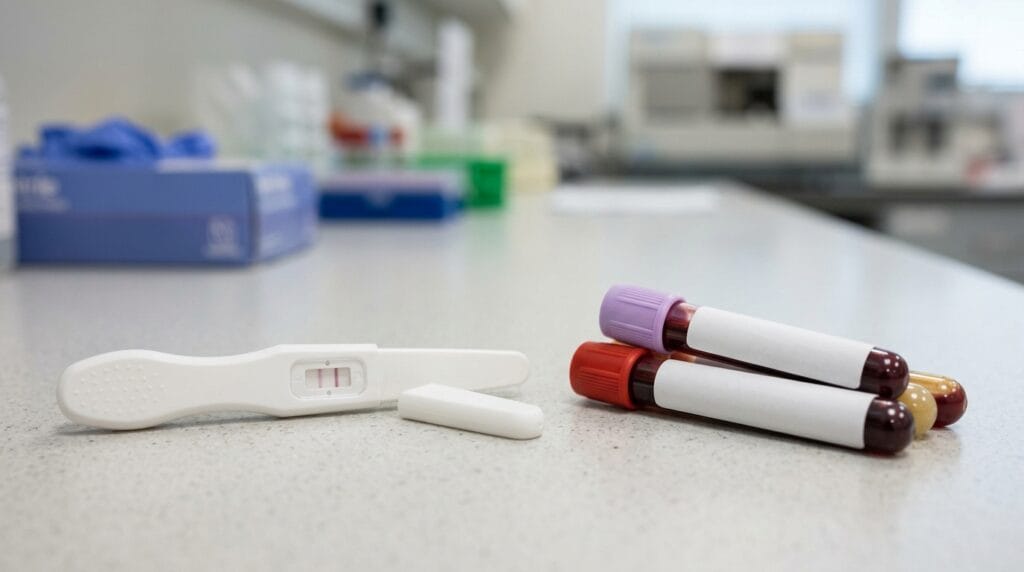
If your period is late and pregnancy is possible, take a home pregnancy test rather than waiting for a unique symptom to appear. Mayo Clinic’s 2026 home-testing guidance notes that results are generally more reliable after the first day of a missed period.
If the result is negative but you still think you could be pregnant, repeat the test later or contact a healthcare professional. With irregular cycles, count from the most recent sexual encounter that could have resulted in pregnancy instead of relying only on a predicted period date. Follow the test directions carefully and avoid excessive fluid immediately before testing.
If you repeatedly test negative but continue having pregnancy-like symptoms, our guide on negative pregnancy tests when you still feel pregnant explains several possible reasons.
What to Do If You Might Be Pregnant During Perimenopause

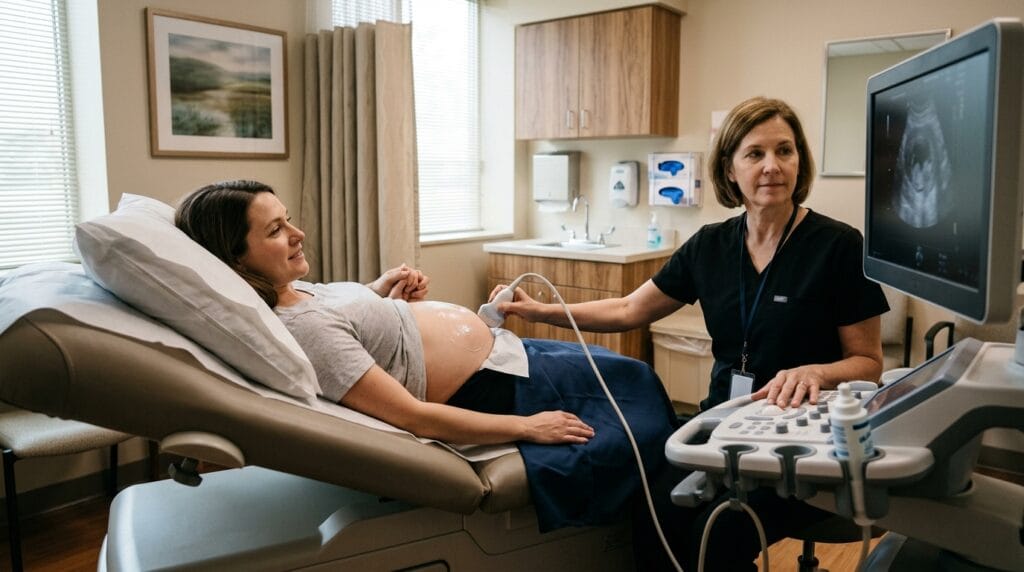
If your pregnancy test is positive, contact a healthcare professional to confirm the pregnancy and discuss next steps. A positive test in your 40s does not automatically mean something will go wrong. Many people have healthy pregnancies later in life. However, age can affect fertility and pregnancy risks, so early prenatal care is useful.
ACOG notes that pregnancy later in life is associated with higher risks of some complications, including miscarriage, chromosomal conditions, high blood pressure-related problems, and stillbirth. Some risks increase more noticeably at age 40 and older. Your individual risk depends on much more than age alone, including your health history and the pregnancy itself.
If you may continue the pregnancy, ask your healthcare professional about a prenatal vitamin containing folic acid and review medications and supplements you currently use. Do not stop prescription medication on your own unless a qualified clinician tells you to do so.
If the pregnancy is unexpected or you are not sure what you want, focus first on confirming the result and getting accurate information. Our step-by-step guide for what to do if you think you might be pregnant can help organize the immediate next steps.
Testing, fertility, and when to call a healthcare professional
If your test is negative and your period returns, the missed cycle may have been related to perimenopause or another temporary change. Track cycle length, flow, spotting, and symptoms for your next appointment.
If you are trying to become pregnant, do not assume that irregular cycles mean conception is impossible. At the same time, fertility declines with age, so waiting a full year before asking for help may not make sense. ACOG recommends discussing an infertility evaluation after six months of trying if you are older than 35. If you are older than 40, ACOG recommends talking with an ob-gyn about evaluation before trying to conceive.
If you do not want to become pregnant, perimenopause should not be treated as birth control. Discuss contraception with a healthcare professional until you have reached menopause or have another reason pregnancy is no longer possible.
medical advice
You should also seek medical advice for bleeding that is very heavy, lasts longer than usual, occurs between periods, or returns after you have gone 12 months without a period. Mayo Clinic advises that bleeding after menopause should be medically evaluated rather than assumed to be a normal period.
Seek urgent medical care if pregnancy is possible and you have severe or worsening abdominal or pelvic pain, especially one-sided pain, along with heavy bleeding, fainting, severe dizziness, shoulder pain, or significant weakness. These symptoms can have several causes, but they require professional evaluation and should not be diagnosed from an online symptom list.
Bottom line: If you are wondering can you get pregnant during perimenopause, the answer is yes. Ovulation becomes less predictable and fertility declines, but pregnancy can still happen before menopause is complete. A missed period after 40 may be caused by perimenopause, pregnancy, or something else. Because the symptoms overlap, a properly timed pregnancy test and medical follow-up are more reliable than trying to diagnose the cause from symptoms alone.
This article is for general educational purposes only and is not a substitute for diagnosis, contraception counseling, fertility care, prenatal care, or personalized medical advice from a qualified healthcare professional.