

Comparing a blood hCG test vs urine pregnancy test can help you understand why healthcare professionals sometimes recommend laboratory testing after a home pregnancy result. Both methods detect human chorionic gonadotropin, commonly called hCG, but they do not provide identical information.
A home urine test can often confirm pregnancy without a clinic appointment. However, some medical situations require more detailed evaluation.
A laboratory blood test may help assess an uncertain pregnancy result or support follow-up when bleeding, pain, or other concerns arise.
Still, neither type of test can independently prove that a pregnancy is developing normally.
This 2026 guide explains the differences between blood and urine testing, how timing affects results, and when a healthcare professional may recommend additional investigations.
How Blood and Urine Pregnancy Tests Detect hCG
After pregnancy begins developing, placental tissue produces hCG.
This hormone enters the bloodstream and can also appear in urine.
Pregnancy tests identify hCG through laboratory or home testing methods.
However, the amount of hormone present changes over time, especially during early pregnancy.
Test timing and individual circumstances therefore influence the results.
Understand how home urine pregnancy tests work
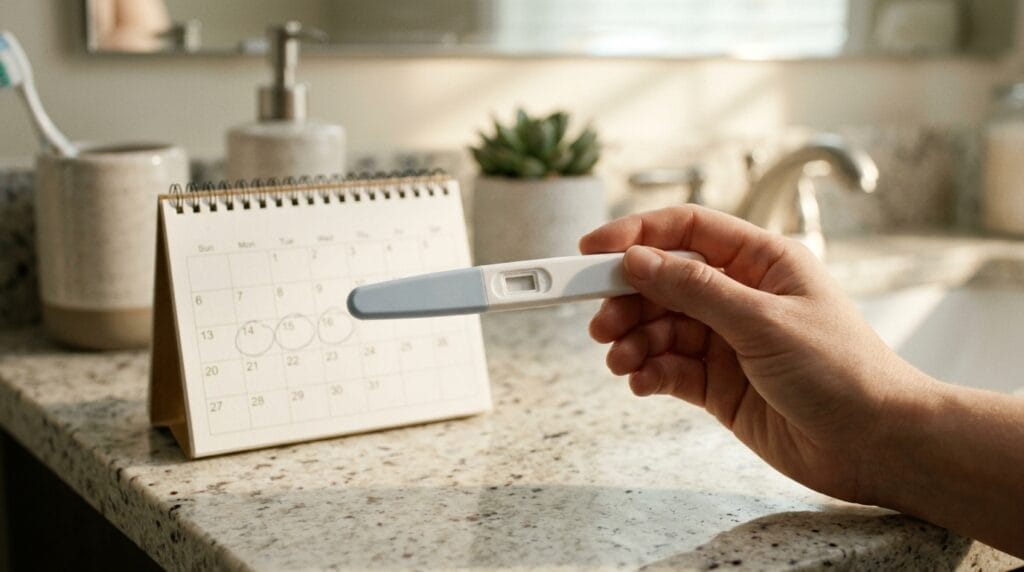
Most home pregnancy tests require urine applied to a test strip or collection device.
After the specified waiting period, the test displays a result through lines, symbols, or a digital indicator.
When used correctly at an appropriate time, home tests can be highly reliable.
However, taking one too early can lead to a false negative.
Why testing before a missed period can be misleading
Ovulation does not always occur on the same cycle day.
After fertilization and implantation, hCG begins rising, but the concentration may initially be too low for a urine test to detect.
Therefore, testing several days before a predicted period can produce a negative result even when pregnancy later becomes detectable.
Mayo Clinic’s updated April 2026 guidance explains that testing after the first day of a missed period generally improves reliability.
For additional information, see its home pregnancy testing guide.
How urine concentration affects test results
Urine hCG concentration can vary depending on fluid intake and the time of testing.
First-morning urine may help when testing particularly early because it is often more concentrated.
However, follow the instructions supplied with your specific test.
Avoid deliberately drinking excessive water immediately before testing.
Check the expiration date and read the result only during the manufacturer’s stated interpretation window.
Our late period after Plan B guide explains why timing matters when a cycle becomes unpredictable.
Understand qualitative and quantitative blood hCG tests
Healthcare professionals can order blood tests when additional information is needed.
A qualitative blood hCG test reports whether the hormone is detected according to the laboratory’s threshold.
A quantitative blood hCG test reports a numerical concentration, usually expressed in international units per liter or equivalent units.
The numerical result provides information that an ordinary home test does not.
However, one number cannot answer every clinical question.
Why clinicians sometimes order repeat blood tests
During an early pregnancy evaluation, a clinician may compare quantitative hCG results collected at different times.
The pattern can contribute to understanding how the pregnancy is progressing.
However, normal ranges overlap, and an hCG trend cannot by itself confirm that a pregnancy is located inside the uterus.
Clinical history, symptoms, and ultrasound findings remain essential.
Do not use a single online doubling-time calculator to diagnose pregnancy viability or miscarriage.
When Is a Blood Pregnancy Test More Useful?
For someone whose period is late and whose home test is clearly positive, a routine blood test may not always be necessary.
However, blood testing can help when the result is uncertain, the medical history is complex, or symptoms require evaluation.
The appropriate method depends on the clinical question rather than which test appears more advanced.
Decide when to contact a healthcare professional
Seek professional guidance if pregnancy tests remain confusing, menstrual periods are persistently absent, or a positive result is accompanied by concerning symptoms.
For example, bleeding and pelvic pain may require investigation beyond a home pregnancy test.
A clinician may order blood testing, ultrasound, or another assessment.
Choosing the tests should reflect the individual situation.
What if blood and urine results disagree?
Occasionally, different tests produce results that appear inconsistent.
Possible explanations include testing thresholds, timing, specimen differences, and analytical interference.
Rarely, persistently positive hCG results can have causes other than an ongoing pregnancy.
ACOG published clinical guidance in February 2026 describing how professionals should evaluate unexpected positive hCG findings.
Rather than making conclusions from conflicting reports, ask your clinician to review the complete results and determine appropriate follow-up.
Blood testing does not replace ultrasound

Ultrasound provides anatomical information that hCG tests cannot supply.
For instance, it may help identify where a pregnancy is developing.
Blood hormone levels do not independently confirm pregnancy location.
When an ectopic pregnancy is possible, clinicians may use ultrasound together with laboratory tests and symptoms.
Our prenatal testing guide explains other important distinctions between screening and diagnosis.
Do not compare your hCG number with strangers online
Online forums often share individual test values and pregnancy outcomes.
However, the same approximate hCG concentration can occur in different clinical situations.
Gestational dating, laboratory methods, and individual variation affect interpretation.
Your healthcare team can explain what the result means in context.
A number that differs from another person’s result does not automatically signal a problem.
Understand the limits of serial hCG measurements
Repeated blood tests can provide useful information, but their interpretation requires medical expertise.
There is no single pattern that independently proves every pregnancy outcome.
Clinicians assess the results alongside symptoms, examination findings, and ultrasound.
If follow-up is recommended, attend the appointment even when you feel well.
Some serious complications initially produce few obvious symptoms.
Recognize when pregnancy symptoms require urgent care
Seek immediate medical evaluation for severe or worsening abdominal pain, major dizziness, fainting, shoulder pain, or heavy bleeding.
These symptoms can occur with serious conditions, including ectopic pregnancy.
Do not postpone care because a recent home test was negative or because you are awaiting a laboratory result.
Tell emergency clinicians about possible pregnancy and any recent test results.
What if you have irregular cycles?
When menstrual cycles vary considerably, the predicted date of a missed period may be unreliable.
Consequently, a home test taken on an app-generated date may be premature.
Ask a clinician about appropriate timing if repeated results remain negative and menstruation does not return.
Do not assume a late period always means pregnancy.
Illness, stress, hormonal conditions, medications, and other factors can affect cycle timing.
Understand laboratory reporting ranges
Laboratories may use different reporting cutoffs for negative, indeterminate, and positive hCG results.
Review the reference information supplied with your actual report.
An indeterminate result may require another test after an appropriate interval.
Do not apply one laboratory’s thresholds to a report from a different facility without professional interpretation.
Your clinician can explain whether the result calls for follow-up.
When a positive test is unexpected
A positive pregnancy result can raise practical or emotional questions.
Some people feel excited, while others feel uncertain or need more information before making decisions.
Medical care should provide accurate explanations without pressure or judgment.
Ask about the options and services relevant to your circumstances.
For general next steps, read our guide for anyone who thinks they may be pregnant.
How to prepare for a blood test appointment
Ask whether the laboratory requires an appointment and whether there are any specific instructions.
Bring the requested identification, referral, or insurance information.
Tell the clinician about relevant medications and fertility treatments.
Some fertility medications containing hCG can affect pregnancy-test interpretation.
Do not stop medication simply because you plan to have a test.
Do you need a blood test after every positive home test?
Not necessarily. Many pregnancies are initially identified through urine tests.
The next step may be arranging prenatal care rather than repeating the same confirmation process.
However, certain medical situations require additional testing.
Discuss the need for blood measurements with a healthcare professional who knows your history.
Testing should answer a useful clinical question rather than simply create more numbers to analyze.
What about false-positive pregnancy results?
False-positive results are less common than early false-negative urine results, but they can occur.
Interpretation errors, recent pregnancy, certain fertility medications, and unusual laboratory interference are possible explanations in different circumstances.
Persistently unexpected results require clinician-led evaluation.
ACOG’s February 2026 guidance particularly emphasizes avoiding unnecessary interventions when an hCG result does not match the clinical picture.
What to remember in 2026
The comparison of blood hCG test vs urine pregnancy test is not simply a question of which method is better.
Urine tests provide accessible initial detection, while blood tests can help with specific medical questions and follow-up.
Neither replaces ultrasound when pregnancy location needs evaluation.
Use tests at the appropriate time and ask a healthcare professional to interpret confusing results.
Medical disclaimer: This article provides general education and does not replace laboratory interpretation, diagnosis, or individualized medical care.