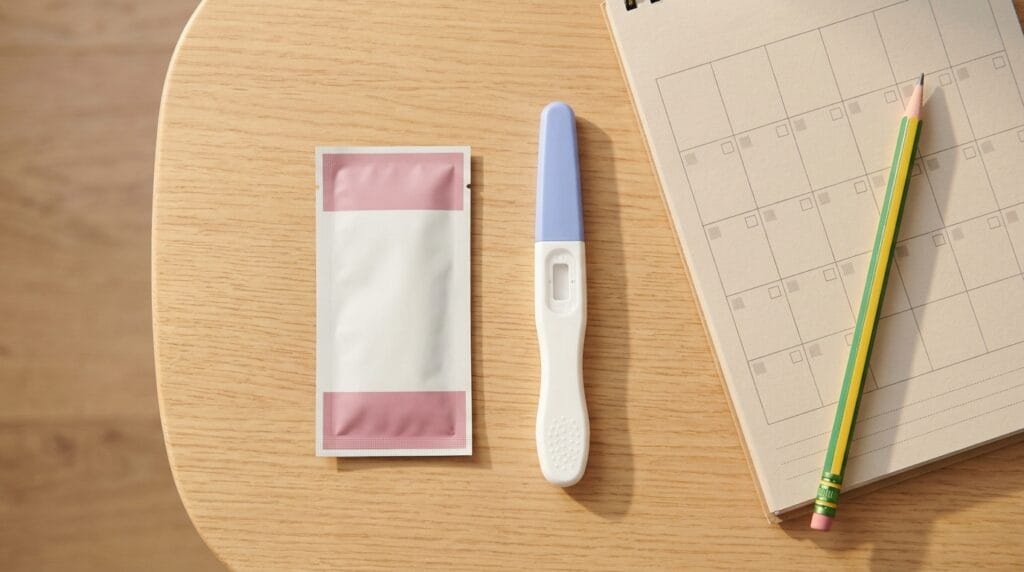

Medical note: This article is for general education only and cannot replace individualized advice, diagnosis or care from a qualified healthcare professional.
Early pregnancy testing promises answers at the exact moment uncertainty feels hardest. An advertisement may say a test can detect pregnancy several days before your missed period. Yet you might see a negative result one morning and a positive result later that week. Those results can feel contradictory, even when the test worked exactly as designed. Timing makes an enormous difference.
A 2026 study of real-world home testing offers a useful reality check. Researchers examined thousands of reported pregnancy tests from people who eventually detected a pregnancy. They found that detection before an expected period was much less dependable than detection afterward. The findings do not mean early tests are useless. They mean an early negative should be interpreted with caution, especially when your cycle is unpredictable.
This guide explains the evidence behind early pregnancy testing, the difference between an early negative and a reliable negative, and how to choose your next step without feeling compelled to test every few hours. It is educational information, not a substitute for personal medical advice.
Why Early Pregnancy Testing Can Miss a Real Pregnancy
Home tests look for human chorionic gonadotropin, usually shortened to hCG, in urine. Your body begins producing detectable amounts after implantation. Because implantation and hormone buildup happen on individual timelines, a test cannot give the same answer to everyone on the same cycle day. A box may advertise an early detection window, but that does not guarantee detection for every pregnancy.
If the expected period date is wrong by even two or three days, you may be testing much earlier than you believe. Ovulation does not reliably happen on day 14 for everyone. Illness, travel, cycle variation and other factors can shift its timing.
What the 2026 Real-World Study Found
A study published in Fertility and Sterility in June 2026 analyzed 19,908 pregnancy tests from 5,979 people who ultimately identified a pregnancy using a home test. Test positivity rose as the expected period approached and passed. Within that study population, more than 99% had reported a positive test by four days after their expected period date. That is a cohort finding, not a guarantee about every pregnancy or every testing situation.
The researchers also found that cycle length influenced test sensitivity, particularly among people testing before their expected period. In other words, two people testing the same number of days before their predicted periods could have different chances of getting a positive result. Read the 2026 home pregnancy testing study for the full research context.
Why a Negative Test Before Your Period Is Not Final
An early negative means the test did not detect enough hCG in that urine sample at that moment. It does not prove fertilization or implantation did not occur. The U.S. Food and Drug Administration advises repeating a test after several days when pregnancy remains possible. The additional time may allow hCG to reach the detection threshold.
Another 2026 analysis found people who tested more than four days before their expected periods were far more likely to experience a negative result before a later positive result than people who waited until their periods were due. This pattern reflects the limits of early detection rather than a failure of the person taking the test.
Cycle Length Matters More Than a Calendar App Suggests
Cycle tracking is useful for recording patterns, but a predicted date is still an estimate. If your last period began on a particular day, the app may assume your next period will arrive after an average number of days. Actual ovulation can vary from cycle to cycle. A delayed ovulation can make a perfectly functional pregnancy test seem negative when you expected an answer.
This matters especially if your periods are irregular, you recently stopped hormonal contraception, you are breastfeeding, or your cycles are changing. If you cannot confidently predict a period, the NHS advises testing at least 21 days after unprotected sex. Our guide to when to take a pregnancy test explains the broader timing basics.
How Home Pregnancy Tests Detect hCG
A home pregnancy test is generally a qualitative test: it reports whether hCG has been detected above a threshold. It does not measure the exact concentration of the hormone or tell you whether a pregnancy is progressing normally. A laboratory blood test can sometimes detect or measure hCG at lower levels, but even a blood result requires interpretation in context.
Follow the manufacturer’s directions for urine collection, the amount of time to wait and the specific result window. An expired test, an absent control line, or a result read well after the instructed window may be unreliable. A faint line visible within the correct reading period may represent a positive result; guessing from a photograph hours later is not a dependable method. Our related article on faint positives and evaporation lines covers that distinction.
Why Marketing Claims Need Context
A claim such as “detects pregnancy six days sooner” often describes what a particularly sensitive test may do in some pregnancies, not what it will do every time. Manufacturers may report laboratory sensitivity, clinical detection rates or marketing language based on specific assumptions. Those measures are not interchangeable. Your personal hCG pattern, urine concentration and actual ovulation date still matter.
The best purchase is usually a test with clear instructions, a valid expiration date and an easy-to-read result. If you are comparing digital tests with standard test strips, the most important questions are when you are testing and how well you follow the device instructions, not whether the device looks more technologically advanced.
A Practical Testing Plan for Clearer Answers
You do not need to test every day to make a sensible decision. Start by identifying whether you know when your period was expected. If your cycle is usually predictable, testing on or after the first missed day is a reasonable approach. If you are testing earlier for personal reasons, treat a negative as provisional and plan to test again after your period is due.
If pregnancy is possible and your first test is negative, try waiting a few days before retesting. Use first-morning urine when testing very early, because it is often more concentrated. Do not deliberately drink large amounts of water just before testing, and do not assume a new test brand will automatically solve an early timing problem.
What to Do After a Negative, Positive, or Unclear Result

For a negative result before the expected period, note the date and retest when the period is due or afterward. For a negative result after a missed period, repeat according to the kit directions or seek advice if menstruation remains absent. If you are unsure when your period should occur, count from the last unprotected sexual encounter instead of relying only on an app’s prediction.
A clearly positive home pregnancy test usually means hCG has been detected. Contact an appropriate healthcare professional to discuss pregnancy care, questions about medications, and any symptoms that need assessment. If the result looks unclear, check the control line and reading time rather than repeatedly inspecting a dried test. You can also review our article about blood hCG tests versus urine pregnancy tests to understand when clinical testing may help.
Keep in mind that symptoms cannot settle the question. Breast tenderness, cramping, tiredness, nausea and bloating can overlap with premenstrual changes, illness and stress. A person may have early pregnancy without noticeable symptoms. They may also have strong symptoms with a negative test for reasons unrelated to pregnancy. Use symptoms as a reason to seek advice when needed, not as a substitute for test timing.
When to Contact a Healthcare Professional
Seek advice if repeated tests give conflicting results, a missed period persists despite appropriate testing, or you have a history that makes interpretation difficult. A clinician may consider additional testing or evaluate other causes of a missed period. A single hCG measurement cannot by itself establish pregnancy location or viability, so follow-up may be necessary in some situations.
Get urgent medical attention for severe or one-sided pelvic pain, shoulder-tip pain, fainting, marked dizziness or heavy bleeding, particularly when pregnancy is possible. These symptoms can occur with an ectopic pregnancy or another urgent condition. Do not wait for a home test to become positive before seeking emergency care. ACOG’s ectopic pregnancy guidance explains why prompt assessment matters.
The takeaway from the 2026 research is reassuringly practical: testing earlier may provide an earlier positive for some people, but it also creates a greater chance of an unhelpful negative. An early result is one point in time, not a verdict on your body. When you know when to retest and when to ask for care, you can make an informed decision without letting every test strip control your day.